

Sita Gufa Nashik
- Home
- Sita Gufa Nashik
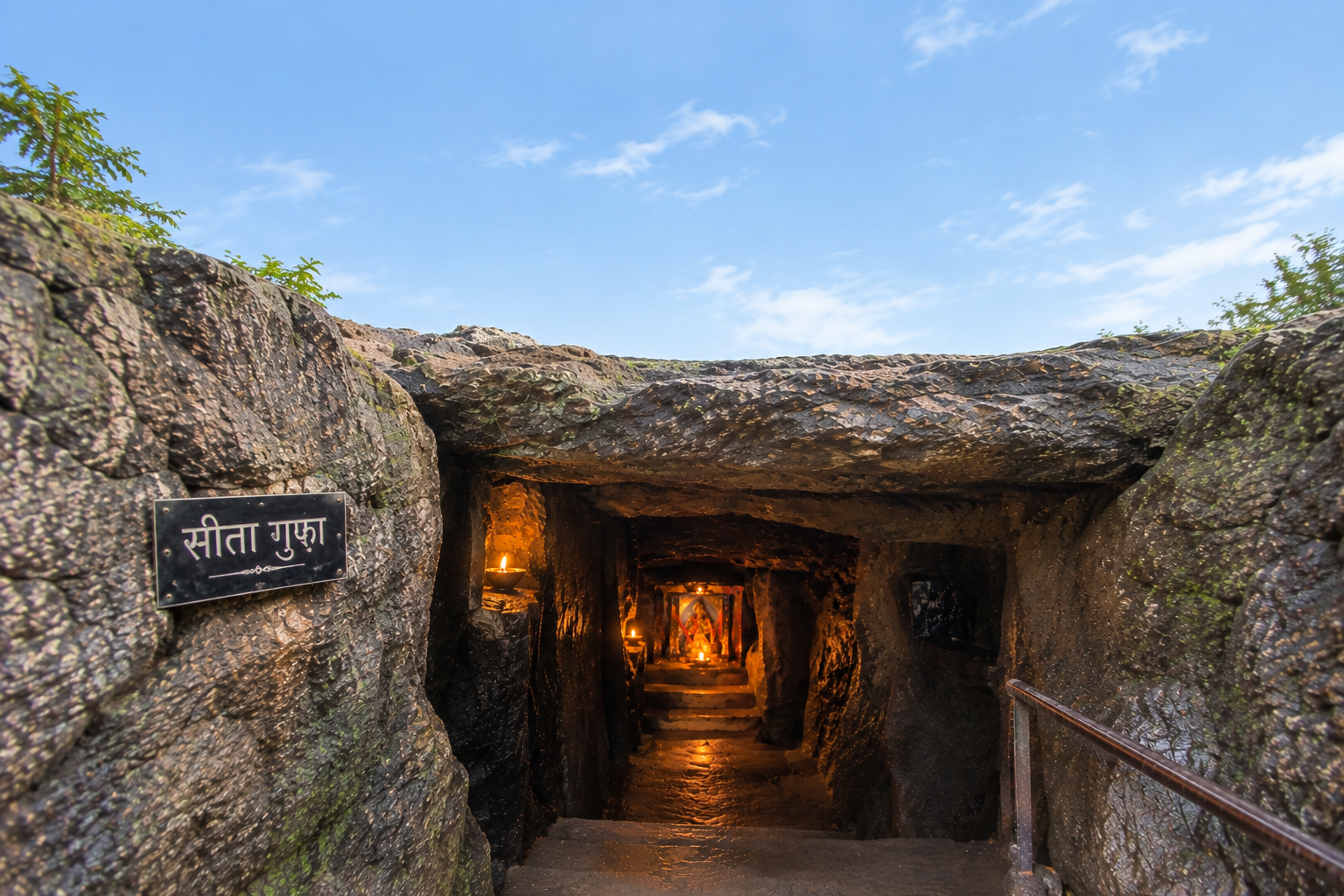

Sita Gufa Nashik
Nestled in the ancient, labyrinthine lanes of Panchavati, just a stone’s throw away from the sacred steps of the Godavari Ghat, lies a dark, narrow, and unassuming rock-cut cave that holds within its damp walls one of the most pivotal, heart-wrenching moments in Hindu mythology. This is the Sita Gufa—the cave of Sita.
Unlike the grand, towering spires of the Trimbakeshwar Temple or the vast, open expanse of the Ramkund ghats, Sita Gufa is claustrophobic, silent, and eerily still. It does not echo with the loud chants of a thousand priests; instead, it whispers the silent screams of a goddess who was stolen from her rightful place.
To step into this cave is to step back in time, into the dense Dandakaranya forest of the Treta Yuga, where the epic Ramayana reached its tragic climax. This is not merely a tourist attraction; it is a dark, historical marker of the moment Ravana, the demon king of Lanka, crossed the line of cosmic law and set in motion the war that would define the age.
If you are planning a pilgrimage to Nashik—especially during the monumental Nashik Kumbh Mela 2027—understanding the profound, somber energy of the Sita Gufa is essential to comprehending the full spiritual spectrum of this holy city. This comprehensive guide will take you deep inside this legendary cave, exploring its mythology, its architecture, its connection to the surrounding Panchavati heritage, and everything you need to know before you descend into its shadows.
The Spine-Chilling Legend of Sita Gufa
To understand the significance of Sita Gufa, one must rewind the epic to the moment when Lord Rama, Sita, and Lakshmana were happily residing in their humble hermitage (Panchavati Ashram), which was located just a few hundred meters from this very cave.
The tranquility of the forest was shattered by the arrival of Shurpanakha, the sister of the demon king Ravana. Infatuated by the handsome Rama and Lakshmana, Shurpanakha attempted to seduce them. When she was mocked and rejected, she lunged at Sita with violent intent. In an act of fierce protective rage, Lakshmana drew his sword and cut off Shurpanakha’s nose and ears.
Humiliated and bleeding, Shurpanakha fled to Lanka and complained to her brother, Ravana. Fueled by rage and a burning desire for revenge, Ravana devised a cunning, meticulous plan. He knew he could not defeat Rama in a direct fight, so he decided to strike at his heart—Sita.
The Deception Unfolds:
Ravana enlisted the help of his uncle, the shape-shifting demon Maricha. Maricha transformed himself into a magnificent, golden deer with silver spots, a creature of such ethereal beauty that it instantly captivated Sita’s attention. She begged Rama to capture it for her. Despite Lakshmana’s protests, Rama chased the deer deep into the forest.
The Moment of Abduction:
Once Rama was far away, Ravana disguised himself as a wandering, aged Brahmin sage and approached the hermitage. Bound by the ancient laws of hospitality, Sita stepped forward to offer him alms. At that precise moment, Ravana dropped his disguise, revealing his monstrous, ten-headed form. He grabbed Sita, lifted her onto his flying chariot (Pushpaka Vimana), and soared into the sky.
Where does the cave fit in?
According to local lore and the regional adaptation of the Ramayana, Ravana did not take Sita directly to Lanka. He flew her over the Godavari river and landed in this very cave to hide temporarily, allowing his demons to regroup and ensuring his escape route was clear before making the long journey south to Lanka. Other versions of the folklore suggest that Sita was kept in this cave for a brief period while Ravana’s forces prepared for the flight.
Walking into this cave today, you can feel the heavy, palpable weight of that cosmic crime. The thick, cold darkness seems to absorb all sound, as if the stones themselves are still mourning the violation that occurred here millennia ago.
The Architecture and Layout of the Cave
Sita Gufa is not a massive, spacious cavern. It is a narrow, rugged, and intentionally claustrophobic space carved out of solid basalt rock. It is designed to evoke the harsh, primitive living conditions of the forest dwellers of that era.
What to Expect Inside:
- The Narrow Entrance: The entrance to the cave is relatively small and unassuming. You have to bend your head slightly to step over the threshold, a symbolic act of humbling oneself before entering the sacred, tragic space.
- The Dark Passage: Once inside, you are immediately struck by the oppressive darkness. The cave is not electrically lit in a modern sense; instead, it relies on dim, ambient lighting and oil lamps placed in niches. This lack of harsh light preserves the ancient, mysterious atmosphere.
- The Triple Sanctum: The cave is divided into three chambers, each housing ancient stone idols:
- The Sita Idol: In the central chamber, you will find a deeply revered idol of Sita, carved from black stone. Her posture is one of patience and quiet strength.
- The Rama and Lakshmana Idols: Flanking the central chamber are separate alcoves housing small, weathered idols of Lord Rama and Lakshmana. These idols show signs of extreme age and are covered in vermilion and turmeric offered by devotees.
- The Low Ceiling: The roof of the cave is deliberately low. Tall visitors often have to crouch significantly, especially in the inner passageways. This is believed to be a symbolic reminder of the humility required before the divine, as well as a practical defensive feature of the ancient cave.
There is a haunting stillness inside the cave. The air is cool and damp, and the constant dripping of water from the ceiling creates a rhythmic echo that feels almost like the heartbeat of the earth. It is a sharp, jarring contrast to the bustling, sun-drenched chaos of the nearby Godavari Ghats.
The Adjacent Temple and the Surrounding Heritage
Right above the Sita Gufa, seamlessly integrated into the rock, stands a small, vibrant Hindu temple. While the cave itself represents the dark deed of Ravana, the temple above represents the triumph of devotion and the continuous worship of the divine couple.
Key Features of the Complex:
- The Main Shrine: The upper temple houses beautifully decorated idols of Rama, Sita, and Lakshmana, presented in a regal, standing posture. This is where the daily rituals (Aarti and Abhishek) take place.
- The Hanuman Temple: Adjacent to the main shrine is a smaller temple dedicated to Lord Hanuman. Given that Hanuman was the ultimate messenger who later crossed the ocean to find Sita, his presence here is considered highly significant. Devotees who visit the cave always take a moment to pray to Hanuman here, asking for strength and courage.
- The Panchavati Trees: The cave is situated in the heart of Panchavati, which literally translates to the “Garden of Five Banyan Trees.” Although the original five trees have perished over the centuries, the area still boasts ancient, sprawling banyan trees with aerial roots that create a mystical canopy over the entire complex.
The Trinity of Panchavati:
To truly appreciate your visit to Sita Gufa, you must visit it in conjunction with its two neighboring landmarks. Your pilgrimage to this area should follow this triangle:
- Ramkund: Take a holy dip in the Godavari where Lord Rama bathed.
- Sita Gufa: Walk the few hundred meters to this cave to witness the spot of Sita’s abduction.
- Kalaram Temple: End your journey at the grand Kalaram Temple (just a kilometer away), which houses the massive black idols of Rama, Sita, and Lakshmana.
Walking this triangle allows you to physically relive the geography of the Ramayana, moving from peace (Ramkund) to tragedy (Sita Gufa) and finally to divine kingship (Kalaram Temple).
Sita Gufa and Its Role in the Nashik Kumbh Mela 2027
The Sita Gufa, while a relatively quiet spot for most of the year, becomes a significant pilgrimage node during the massive Nashik Kumbh Mela 2027. When millions of devotees flood the city for the Amrit Snan at the Godavari Ghat, they do not just come to bathe; they come to complete a full circumambulation (Parikrama) of the holy sites of Panchavati.
Why the Cave Matters During the Kumbh:
- The Spiritual Detox: Many sadhus and ascetics who attend the Kumbh Mela retreat to the quiet, shadowy confines of the Sita Gufa to meditate. They believe that meditating in the same darkness where Sita meditated gives them unparalleled spiritual strength.
- The Parikrama Route: During the Kumbh, local guides organize massive walking processions that start at Ramkund, pass through the Sita Gufa, and culminate at the Kalaram Temple. The narrow lane leading to the cave is lined with hundreds of temporary stalls offering puja materials and mythological prints.
- The Pause in the Chaos: For ordinary pilgrims, the Kumbh Mela can be overwhelming due to the sensory overload of the crowds and the river. The Sita Gufa offers a rare, quiet respite. Stepping inside the cool, dark cave provides a psychological “reset” before diving back into the intense festivities of the river ghats.
If you are visiting for the 2027 Kumbh, schedule your visit to Sita Gufa for a late afternoon slot. It allows you to avoid the harsh sun, experience the dim lighting of the cave at its most atmospheric, and then step out just in time to walk back to the Godavari Ghat to catch the spectacular evening Aarti.
Practical Travel Guide: Visiting Sita Gufa
To ensure your visit is respectful, safe, and rewarding, here is a detailed breakdown of practical information.
Timings and Entry:
- Opening Hours: The temple complex and cave are open from 6:00 AM to 9:00 PM daily.
- Entry Fee: There is no entry fee to visit the cave or the temple. However, you may be approached by temple priests for offering donations (Prasad) which are entirely voluntary.
Best Time to Visit:
- Morning (7:00 AM – 9:00 AM): The cave is naturally cooler, and the morning sunlight filters in through the crevices, creating a mystical, ethereal glow inside.
- Evening (5:00 PM – 7:00 PM): The temple performs a small Aarti in the evening. The dimming outside light makes the interior lamps and diyas feel even more dramatic.
- Seasonal: October to March (Winter) is the most comfortable season. The narrow lane leading to the cave can become extremely congested and muddy during the heavy monsoon rains.
Essential Tips for Your Visit:
- Beware of Claustrophobia: This is the single most important tip. The inner passage of the Sita Gufa is incredibly narrow and low. If you suffer from claustrophobia (fear of enclosed spaces) or have respiratory issues like asthma, it is highly recommended to stay in the outer chamber and avoid squeezing into the deepest, darkest recesses of the cave.
- Footwear: You must remove your footwear before entering the cave and the temple complex. There is a small shoe-keeping stand near the entrance, but it can get crowded. It is advisable to carry a plastic bag to keep your shoes with you if you don’t want to risk losing them.
- Dress Code: Modest, traditional attire is appreciated. Women are advised to cover their heads with a scarf or dupatta when entering the temple sanctum above the cave.
- Photography: Photography is strictly prohibited inside the cave sanctum. The priests are very vigilant about this rule. You can take photos of the exterior architecture and the surrounding trees, but please respect the sanctity of the inner chambers.
- Mind Your Head: Keep your head bowed and move slowly. The ceilings are low, and it is very easy to bump your head against the hard basalt rock while navigating the dark corridors.
The Deep Emotional Resonance of Sita Gufa
Beyond the mythology and the tourism, visiting the Sita Gufa is a deeply emotional and psychological experience. In a world obsessed with the glory of Rama—the victorious king—this cave forces you to confront the vulnerability of the divine.
Sita, the daughter of King Janaka, the wife of Rama, is worshipped as the embodiment of patience, sacrifice, and loyalty. This cave represents the absolute nadir of her earthly journey. It was here that she was ripped away from her husband, her security shattered, and her future thrown into uncertainty.
Standing in that suffocating darkness, you realize that the Ramayana is not just a story of good versus evil; it is a story of resilience. The cave teaches you that even in your darkest, most claustrophobic moments, you can find strength. It is a place of healing for many women who visit to pray for the safety and longevity of their husbands, channeling the protective spirit of Sita.
It is a stark, raw, and brutally honest piece of history. It does not try to glorify the abduction; it simply stands as a silent, aching witness to it. And that authenticity makes it one of the most powerful spiritual sites in Nashik.
Frequently Asked Questions (FAQs)
Q: Where is Sita Gufa located in Nashik?
A: Sita Gufa is located in the historic Panchavati area of Nashik, Maharashtra. It is situated just a few hundred meters away from the sacred Ramkund and the Godavari Ghat riverfront.
Q: What is the story behind Sita Gufa?
A: Sita Gufa is believed to be the cave where Sita was briefly held or hidden by the demon king Ravana after he abducted her from the Panchavati hermitage. It marks the tragic turning point in the Ramayana epic.
Q: Is it safe to enter Sita Gufa?
A: It is safe for most visitors, but the cave is extremely narrow, dark, and claustrophobic with very low ceilings. People with heart conditions, severe asthma, or claustrophobia should avoid going into the deep inner chambers.
Q: What are the timings of Sita Gufa?
A: The Sita Gufa and the adjoining temple complex are open daily from 6:00 AM to 9:00 PM. There is no entry fee to visit the cave.
Q: How far is Sita Gufa from Ramkund?
A: Sita Gufa is located very close to Ramkund, approximately a 5 to 10-minute walk (about 400 meters) through the winding lanes of Panchavati.