


Bathing Dates Kumbh Mela 2027
Pandav Caves
Hinayana Buddhist Monastic Complex in Maharashtra
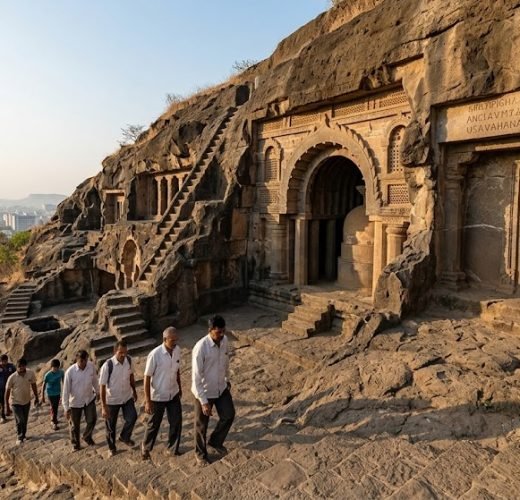
Pandav Caves (Pandav Lani) – Historical Guide
Located approximately 8 kilometers south of Nashik, Maharashtra, the Pandav Caves—locally known as Pandu Leni or Trirashmi Caves—represent one of the most significant Buddhist cave complexes in western India. This group of 24 rock-cut caves, carved between the 3rd century BC and the 2nd century AD, belongs to the Hinayana Buddhist tradition and has no connection whatsoever to the Pandavas of the Mahabharata, despite the popular misnomer. The site holds immense historical and religious importance, offering visitors a fascinating glimpse into ancient Buddhist monastic life.
Cave Architecture & Layout
The architectural brilliance of these caves is truly remarkable. Most of the 24 caves are Viharas (monasteries) designed as living quarters for Buddhist monks, featuring numerous chambers and cells carved into the solid rock. However, Cave No. 18 stands out as a Chaitya (prayer hall) with a beautifully preserved Stupa at its center. The caves are intricately interconnected through stone-cut ladders that join one cave to another, showcasing the engineering skill of ancient craftsmen. Steps lead visitors from the bottom of the hill, making the site accessible while maintaining its rugged, historical charm.
The Trekking Experience
For those seeking adventure alongside history, the peak of Pandavleni is accessible via a well-maintained trekking path with built-in steps. The ascent takes approximately 20 minutes and rewards trekkers with panoramic views of the surrounding Nashik landscape. The caves face eastwards, so early morning visits are highly recommended—as the first rays of sunlight fall upon the cave facades, the intricate carvings and sculptural details come alive with enhanced beauty, creating a truly unforgettable experience for photographers and history enthusiasts alike.
Historical Background & Inscriptions
The historical significance of these caves is deeply rooted in the ancient dynasties that ruled the region. Inscriptions found across multiple caves confirm that Nashik was governed by three prominent dynasties during this period—the Kshatrapas, the Satavahanas, and the Abhirs—who were often in conflict over supremacy. Despite their political rivalries, all three kings supported Buddhism and contributed to the development of these caves. The inscriptions also reveal that local merchants and landlords generously donated funds for the construction and maintenance of the caves.
Cave No. 10, known as the ‘Nahapan Vihar,’ is particularly noteworthy for its spacious layout with 16 rooms and its well-preserved inscriptions. According to inscriptions here, in 105-106 BC, the Kshatrapas defeated the Satavahanas, following which Kshatrapa Nahapana’s son-in-law, Usabhdatta (son of Dinika), donated 3000 gold coins for this cave, as well as for food and clothing for the monks. Usabhdatta’s wife, Dakshmitra (Nahapana’s daughter), also donated one cave for the Buddhist monks.
Things to See & Explore
Visitors can explore several caves with legible inscriptions, including Caves 3, 11, 12, 13, 14, 15, 19, and 20. Cave 15, bearing the inscription ‘Sri Yajna Vihar,’ mentions Sri Yajna Satkarni—the last Satavahana king who ruled over western Maharashtra—indicating that this cave was likely carved around the beginning of the 3rd century AD. Similar inscriptions appear at Cave 3 in Kanheri, confirming the widespread influence of these rulers. Other notable inscriptions mention the names Bhattapalika, Gautamiputra Satkarni, and Vashishthiputra Pulumavi of the Satavahanas, along with two Kshatrapa rulers, Dakshamitra and Ushavadant.
The site also features an excellent ancient water management system, with several attractive water tanks skillfully chiseled out of solid rock—a testament to the advanced engineering capabilities of that era.
Origin of the Name
The caves were originally called “Pundru,” a Pali word meaning “yellow ochre color.” This name derived from the fact that the caves served as residences for Buddhist monks who wore “chivara” or yellow robes. Over time, the word Pundru evolved into “Pandu Caves” (as per the Ancient Monuments Act of 26 May 1909). Decades later, the name transformed into “Pandav Caves”—a misnomer commonly applied to various caves across India, despite having no historical connection to the Mahabharata characters.
Significance of Buddhist Sects
Since the caves were inhabited by both the Mahayana and Hinayana sects of Buddhism, visitors can observe a beautiful confluence of structural styles and carvings, reflecting the diverse influences that shaped Buddhist art and architecture in this region over several centuries.
Key Highlights at a Glance:
Location: 8 km south of Nashik, Maharashtra.
Total Caves: 24 rock-cut caves.
Period: 3rd century BC to 2nd century AD.
Tradition: Hinayana Buddhism (with later Mahayana influence).
Main Caves: Cave No. 18 (Chaitya with Stupa) and Cave No. 10 (Nahapan Vihar with 16 rooms).
Architecture: Viharas, Chaitya, stone-cut ladders, water tanks.
Inscriptions: Found in Caves 3, 10, 11, 12, 13, 14, 15, 19, and 20.
Dynasties Mentioned: Satavahanas, Kshatrapas, Abhirs.
Trekking: 20-minute ascent with well-built steps.
Best Time to Visit: Early morning for enhanced sunlight on carvings.