

Pind Daan & Asthi Visarjan at Kumbh – Simple Step-by-Step Guide
- Home
- Pind Daan & Asthi Visarjan at Kumbh – Simple Step-by-Step Guide

Pind Daan & Asthi Visarjan at Kumbh – Simple Step-by-Step Guide
How Pind Daan and Asthi Visarjan Are Performed at Kumbh – A Simple Step-by-Step Guide
Kumbh Mela is one of the largest spiritual gatherings in India, and it holds deep meaning for Hindus across the world. Many people come to the Kumbh to perform Pind Daan and Asthi Visarjan for their ancestors. These rituals are done to express respect, love, and gratitude toward family members who have passed away. In this guide, you will learn how these rituals are performed at the Kumbh in a simple step-by-step way.
Kumbh Mela is a sacred gathering held at Prayagraj, Haridwar, Nashik, and Ujjain.
Pind Daan and Asthi Visarjan are ancestral rituals performed with the help of trained priests.
These rituals are done near holy rivers like the Ganga, Yamuna, Godavari, and Shipra.
Understanding Pind Daan and Asthi Visarjan at Kumbh
Pind Daan is a ritual in which small round balls of rice, barley, and flour are offered to the ancestors. These offerings are called pind. The ritual is performed to remember and honour the departed souls of family members. Asthi Visarjan means immersing the ashes of a deceased person in a holy river. At the Kumbh, both rituals are often done together because the rivers and ghats are considered highly sacred during this time.
Pind Daan is an offering made to ancestors using rice and flour balls.
Asthi Visarjan is the immersion of ashes in a holy river.
Both rituals are commonly performed at the Kumbh because of the sacred rivers and the large presence of experienced pandits.
The Spiritual Meaning Behind These Rituals
In Hindu tradition, these rituals are seen as a way to show respect to ancestors and to seek their blessings. Families believe that performing them at the Kumbh brings peace to the departed soul and a sense of closure to the living family members. The Kumbh is considered a time when the rivers are especially holy, so many families choose this occasion for these rituals.
The rituals express love and respect for ancestors.
The Kumbh is viewed as a sacred time and place for such ceremonies.
Families often perform these rituals together to stay connected with their roots.
Choosing the Right Kumbh Location and Ghat
Each Kumbh city has its own main ghats where these rituals are performed. In Prayagraj, the Triveni Sangam is the most well-known spot. In Haridwar, the Brahma Kund and Har Ki Pauri are popular. In Nashik, the Godavari river ghats are used, and in Ujjain, the Shipra river ghats are chosen. Families usually select a ghat based on the city they are visiting and the guidance of their pandit.
Triveni Sangam in Prayagraj is a well-known place for these rituals.
Har Ki Pauri and Brahma Kund are common in Haridwar.
Nashik and Ujjain have their own sacred ghats on the Godavari and Shipra rivers.
Preparation Before the Ritual
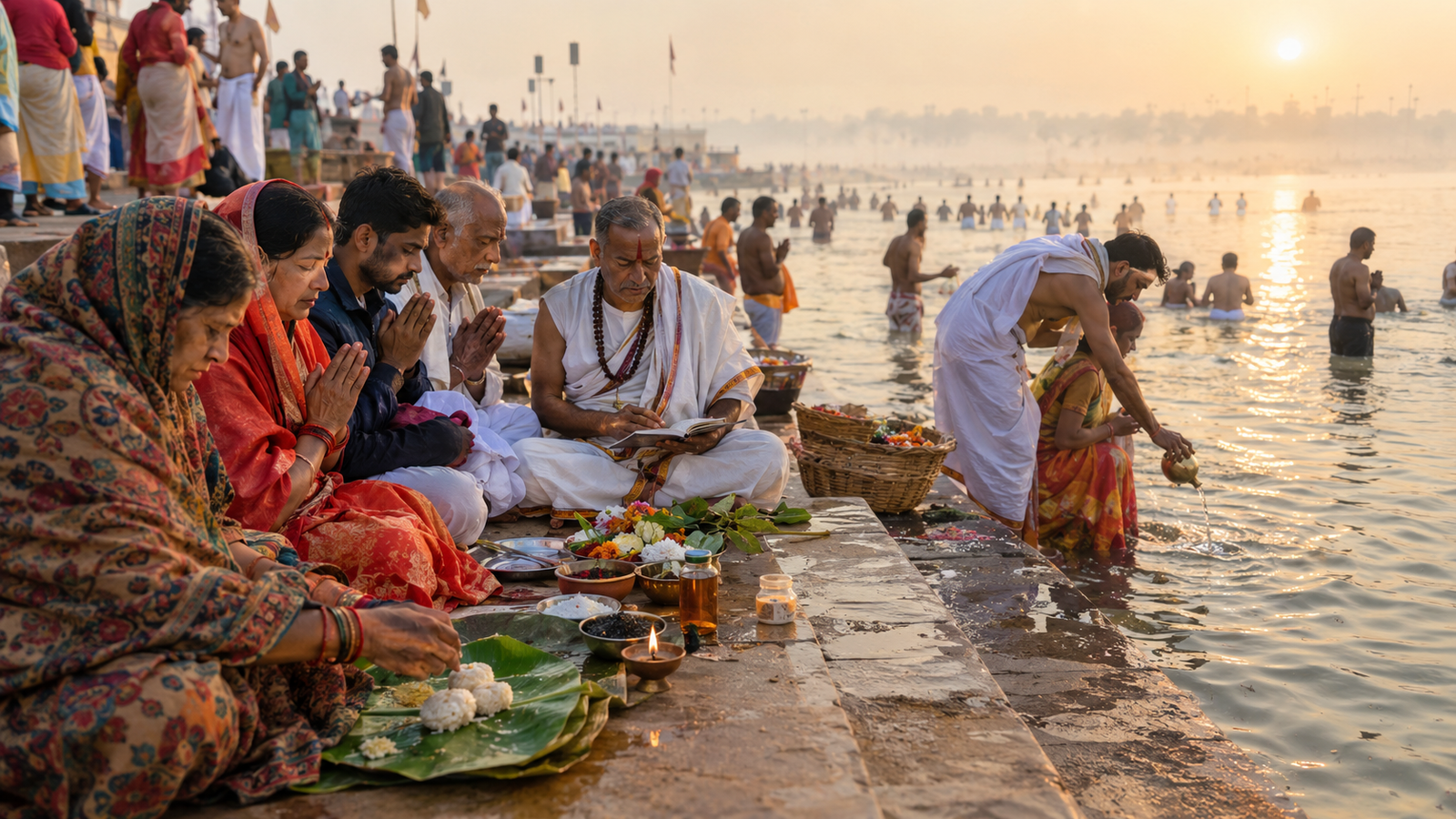
Before the ritual begins, families take a holy bath in the river. They wear clean and simple clothes, usually white or light-coloured. The pandit arranges the samagri, which includes rice, barley flour, black sesame seeds, honey, milk, tulsi leaves, and flowers. A small sankalp is taken, where the family states their name, gotra, and the purpose of the ritual. This step is done to formally begin the ceremony.
A holy bath in the river is taken before the ritual starts.
Clean and simple clothes are worn by the family members.
The pandit prepares the samagri and the family takes a sankalp.
Step-by-Step Process of Pind Daan
The Pind Daan ritual follows a set of steps that are guided by the pandit. First, the family sits facing south, which is the direction linked with ancestors. The pandit chants mantras and the family offers water and sesame seeds. Then, the pind are prepared using rice, barley, and flour. These pind are placed on a banana leaf or a clean plate. The family offers prayers and recalls the names of their ancestors. In the final step, the pind are immersed in the river or given to the pandit for the final offering.
The family sits facing south and offers water and sesame seeds.
Pind are made from rice, barley, and flour and placed on a leaf or plate.
The final step is immersion of the pind in the holy river.
Step-by-Step Process of Asthi Visarjan
Asthi Visarjan is usually performed before or after Pind Daan, depending on the family’s tradition. The ashes are kept in a small pot or a cloth bundle. The family carries the ashes to the ghat and stands near the water. The pandit chants mantras and the family offers flowers and milk to the river. Then, the ashes are slowly immersed in the flowing water. Many families also offer rice, sesame seeds, and a small lamp during this ritual.
The ashes are carried in a pot or cloth bundle to the ghat.
Mantras are chanted and flowers and milk are offered to the river.
The ashes are immersed slowly in the flowing water.
Role of Pandits and Priests
Pandits play an important role in these rituals. They guide the family through each step, chant the mantras, and explain the meaning of the actions. Most ghats have pandits who are experienced in performing Pind Daan and Asthi Visarjan. Families can also arrange a pandit in advance through local contacts or camps. The pandit helps in keeping the ritual simple, correct, and peaceful.
Pandits guide the family through each step of the ritual.
Experienced pandits are usually available at the main ghats.
Advance booking through local camps or contacts is often helpful.
Items and Samagri Needed for the Ritual
The samagri for these rituals is simple and easy to arrange. It usually includes rice, barley flour, black sesame seeds, honey, milk, tulsi leaves, flowers, and a small clay lamp. Some families also bring a banana leaf, a clean cloth, and a small pot for the ashes. Pandits often arrange the samagri for the family, so there is no need to worry about collecting everything on your own.
Common items include rice, barley flour, sesame seeds, honey, and milk.
Flowers, tulsi leaves, and a clay lamp are also used.
Pandits usually arrange the samagri for the family.
Best Time to Perform These Rituals
These rituals can be performed on most days during the Kumbh. Many families choose specific days like Amavasya, Purnima, or the main bathing dates of the Kumbh. Early morning is often preferred because the ghats are calm and the atmosphere is peaceful. The Kumbh period itself is considered a good time for ancestral rituals, so families can choose a date that fits their travel plan.
Amavasya, Purnima, and main bathing dates are commonly chosen.
Early morning hours are peaceful and suitable for the ritual.
The full Kumbh period is considered a good time for these ceremonies.
Performing the Ritual at Major Kumbh Cities
Each Kumbh city has its own way of hosting these rituals. In Prayagraj, the Triveni Sangam is the main spot, and many camps help families with the process. In Haridwar, the ghats near Har Ki Pauri are popular. In Nashik, the Godavari ghats are used, and in Ujjain, the Shipra ghats are chosen. Local pandits in each city are familiar with the traditions followed there.
Prayagraj uses the Triveni Sangam for these rituals.
Haridwar, Nashik, and Ujjain have their own sacred ghats.
Local pandits in each city know the local traditions well.
What to Keep in Mind During the Ritual
Families are advised to keep the ritual simple and focused. Wearing clean clothes, keeping the mind calm, and following the pandit’s instructions help make the experience smooth. It is also good to carry a small bag for personal items and to keep the ghat area clean. Drinking water and light snacks can be kept nearby for elderly family members.
Wear clean and simple clothes during the ritual.
Follow the pandit’s instructions and keep the mind calm.
Keep the ghat area clean and carry water for family members.
After the Ritual
Once the ritual is complete, families often take a light bath or wash their hands and feet. Many families offer food or clothes to the pandit and to people in need as a mark of respect. Some families also feed cows or birds near the ghat. After the ceremony, families usually take some time to sit quietly near the river and remember their ancestors.
A light bath or washing of hands and feet is common after the ritual.
Offering food or clothes to the pandit and to people in need is a common practice.
Many families spend a few quiet moments near the river after the ceremony.
Frequently Asked Questions(FAQs)
Q1: What is Pind Daan?
Pind Daan is a ritual where small balls made of rice, barley, and flour are offered to ancestors. It is done to show respect and gratitude to family members who have passed away.
Q2: What is Asthi Visarjan?
Asthi Visarjan is the immersion of ashes of a deceased person in a holy river. At Kumbh, it is often done along with Pind Daan near sacred ghats.
Q3: Where are these rituals performed at Kumbh?
These rituals are performed at main ghats like Triveni Sangam in Prayagraj, Har Ki Pauri in Haridwar, Godavari ghats in Nashik, and Shipra ghats in Ujjain.
Q4: Do I need a pandit to perform these rituals?
Yes, a pandit usually guides the family through each step and chants the mantras. Many experienced pandits are available at the main ghats during Kumbh.
Q5: What items are needed for Pind Daan and Asthi Visarjan?
Common items include rice, barley flour, black sesame seeds, honey, milk, tulsi leaves, flowers, and a clay lamp. Pandits often arrange the samagri for the family.