

Ramkund Nashik
- Home
- Ramkund Nashik
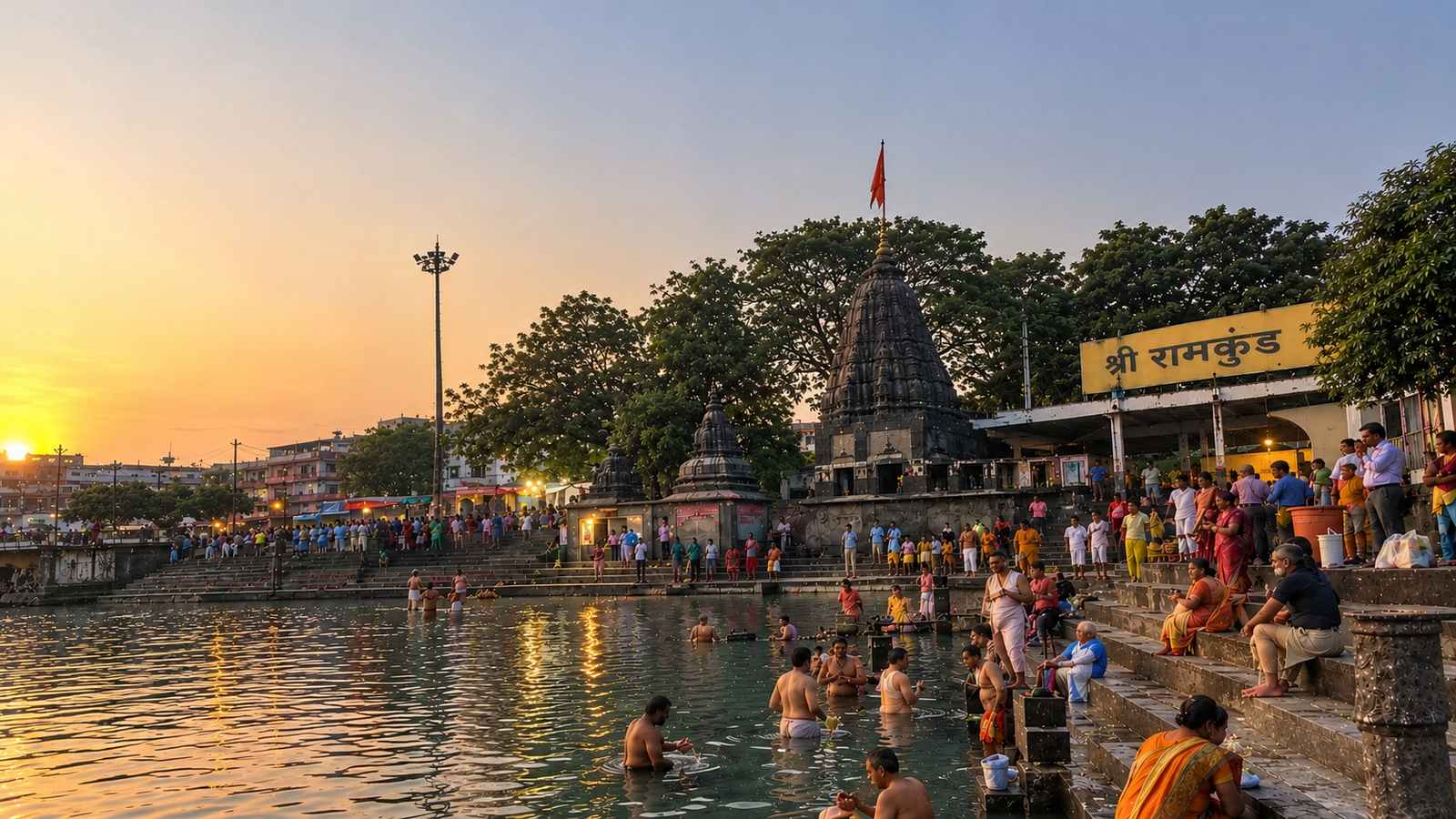

Ramkund Nashik
Nestled in the heart of the ancient Panchavati region of Nashik, along the winding banks of the sacred Godavari River, lies Ramkund – a holy water tank that is far more than just a pilgrimage spot. It is the very soul of the city.
While the grandiose Trimbakeshwar Temple represents the cosmic, esoteric power of Lord Shiva, Ramkund represents the divine, human touch of Lord Rama. This is the place where the epic of the Ramayana literally touched the soil of Maharashtra. For centuries, Ramkund has stood as a silent witness to the ebb and flow of human life, serving as a site of joyous celebration during the Kumbh Mela and a place of profound, somber reflection for those performing the final rites for their ancestors.
If you are planning a spiritual sojourn to Nashik—especially during the massive Nashik Kumbh Mela 2027—understanding the historical, mythological, and ritualistic significance of Ramkund is absolutely non-negotiable. This is where the divine nectar of the Godavari meets the mortal journey of the human soul.
This comprehensive guide will walk you through every stone, every ritual, and every legend associated with this sacred ghat, ensuring you experience Ramkund with the reverence and awareness it truly deserves.
The Mythological Heartbeat: The Legend of Lord Rama and Sita
To stand at Ramkund is to stand at the very spot where history and mythology converge into a single, tangible reality. According to the epic Ramayana, during their fourteen-year exile (Vanvas), Lord Rama, his devoted wife Sita, and his loyal brother Lakshmana traveled extensively through the Dandakaranya forest.
When they arrived at the region now known as Panchavati (which translates to “Garden of Five Banyan Trees”), they were captivated by its natural beauty, abundant wildlife, and the gentle flow of the Godavari River. They decided to establish their hermitage (Panchavati Ashram) here.
The legend states that Lord Rama and Sita were deeply enamored by a particular, naturally formed depression on the riverbank. The water here was crystal clear and incredibly pure. Every day, they would descend the steps of this tank to perform their daily ablutions and offer their prayers to the Sun God.
This specific tank is what we know today as Ramkund.
It is believed that Lord Rama himself consecrated this spot. The water that touched his divine feet is considered to carry the essence of his righteousness (Maryada Purushottam). Because Sita Devi also bathed here, the tank holds a special significance for married couples who pray here for a harmonious and long marital life, mirroring the ideal relationship of Rama and Sita.
The Profound Significance of Asthi Visarjan (Immersion of Ashes)
While the legend of Lord Rama draws millions of tourists and devotees, there is another, equally powerful aspect of Ramkund that commands a deep, reverent silence—the ritual of Asthi Visarjan.
Ramkund is regarded as one of the most sacred and potent places in all of India for immersing the mortal ashes (bones and remains) of the deceased. Hindus believe that the soul continues its journey even after the physical body is cremated. The final ritual of immersing the ashes in a sacred river is known as “Asthi Visarjan,” and it serves as the ultimate farewell, allowing the soul to break free from earthly attachments and achieve ‘Moksha’ (liberation from the cycle of rebirth).
Why is Ramkund specifically chosen over countless other rivers and ghats?
- The Connection to the Source: Unlike many other ghats that are located on the main flow of the river, Ramkund is positioned at a spiritually potent confluence. The water here is directly touched by the divine energy of the Godavari, which originates from the Trimbakeshwar Temple just 28 kilometers away. The water here is considered to be the purest, imbued with the spiritual essence of Sage Gautam’s penance and Shiva’s grace.
- The Rama Connection: Immersing ashes in Ramkund is believed to be equivalent to immersing them directly at the feet of Lord Rama. It is said that Lord Rama, who himself experienced the pain of separation from his father, King Dasharatha, blesses the departed souls here with instant peace.
- The Panchavati Blessing: The presence of the sacred Panchavati trees and the surrounding temples creates a powerful “Tirtha Kshetra” (sacred zone). Priests here perform the Pind Daan (ancestral offerings) with extreme precision, ensuring that the departed ancestors are satisfied and do not wander in the astral planes.
The ghat is perpetually busy with families from across Maharashtra, Gujarat, and even South India, who travel for miles carrying earthen pots filled with ashes and bones. The sight of hundreds of devotees standing waist-deep in the holy water, chanting mantras, and gently releasing the ashes into the current is a deeply moving, humbling experience that stays with you forever.
The Mesmerizing Godavari Aarti at Ramkund
If the Ganga Aarti at Varanasi is a spectacle of cosmic energy, the Godavari Aarti at Ramkund is a spectacle of pure, poetic devotion. Performed every evening as the sun dips below the horizon, this ritual transforms the ghats into a sea of flickering diyas, billowing incense, and powerful Vedic chants.
What to Expect During the Aarti:
The aarti is performed exactly at sunset by a group of dedicated priests dressed in traditional saffron or white dhotis. The ritual lasts for approximately 45 minutes to an hour.
- The Preparation: As dusk approaches, the steps of the Ramkund are cleaned, and hundreds of small clay lamps (diyas) are arranged in beautiful geometric patterns on the stone steps. The main aarti platform is decorated with fresh marigold flowers and mango leaves.
- The Chanting: The atmosphere thickens with the sound of massive conch shells (Shankh) and the rhythmic ringing of large brass bells. The priests begin chanting the “Har Har Gange” or “Godavari Stuti,” praising the river as a living goddess (Devi).
- The Plumes of Fire: The highlight of the ceremony is when the priests raise massive, multi-tiered brass lamps (weighing several kilograms). Each lamp has multiple wicks dipped in ghee. As they swing these lamps in large, synchronized circles, they create enormous plumes of fire that illuminate the dark waters of the Godavari.
- The Floating Blessings: The aarti concludes with devotees lighting their own diyas and setting them afloat on the river. The sight of hundreds of these tiny flames drifting slowly downstream, carrying the silent prayers of thousands, is nothing short of magical.
If you are visiting Nashik, missing the Godavari Aarti at Ramkund is simply not an option. It is the spiritual culmination of your day.
The Unbreakable Bond: Ramkund and the Nashik Kumbh Mela 2027
Ramkund is not just a tourist attraction; it is the epicenter of the Nashik Kumbh Mela. When millions of devotees, sadhus, and tourists converge on the city in 2027, Ramkund will be the beating heart of the entire congregation.
During the Kumbh Mela, the quiet steps of Ramkund swell into a tsunami of humanity. The Amrit Snan (Shahi Snan) processions, which we discussed in our detailed guide on the Nashik Kumbh Mela 2027 Bathing Dates, revolve entirely around this sacred ghat.
Here is why Ramkund is the centerpiece of the Kumbh:
- The Bathing Point: While the Kumbh covers a vast stretch of the Godavari, the most auspicious and sought-after bathing point is specifically at the Ramkund steps. Devotees believe that taking the holy dip right here, where Lord Rama once bathed, multiplies the spiritual merit (Punya) exponentially.
- The Procession Route: All the grand processions of the Naga Sadhus and various Akharas culminate here. The ghats surrounding Ramkund turn into a massive stage where these ascetics perform their ancient rituals.
- The Crowd Management: Understanding the geographical importance of Ramkund is crucial for your safety. During the main bathing dates (July 13, July 22, and July 30, 2027), the area surrounding Ramkund becomes densely packed. It is highly recommended to visit the ghat during the non-peak hours or on the secondary bathing dates if you are claustrophobic or traveling with elderly family members.
If you are planning your itinerary for the 2027 Kumbh, allocate at least two days to simply sit on the steps of Ramkund and observe the confluence of faith, culture, and chaos. It is a sociological spectacle unlike any other.
The Surrounding Panchavati Heritage: Sita Gufa and Kalaram Temple
Ramkund is not an isolated spot. It is the centerpiece of the ancient Panchavati area, which is home to several other historically and spiritually significant landmarks. To maximize your trip, you must explore the immediate surroundings.
1. Sita Gufa (Sita’s Cave):
Located just a short walk (about 200 meters) from Ramkund, the Sita Gufa is a narrow, dark, and winding cave carved out of natural rock. Mythology states that this is the exact cave where Ravana, the demon king of Lanka, abducted Sita. Inside, you will find ancient idols of Sita, Rama, and Lakshmana. The cave is extremely narrow, and you must crouch to walk through its dark passages, which gives you a chilling, immersive glimpse into the epic’s most pivotal moment.
2. Kapaleshwar Temple:
Situated right next to Ramkund, this is an ancient Shiva temple that predates many of the other structures in the city. It is intricately linked to the legend of Lord Brahma and the origin of the ‘Kapal’ (skull) curse. It is a quiet, calming sanctuary amidst the chaos of the ghats.
3. Kalaram Temple:
This is the most prominent temple in the Panchavati area, located about 1 kilometre from Ramkund. The Kalaram Temple is dedicated to Lord Rama and is unique because the main idol is made entirely of black stone (hence ‘Kala’ Ram). The temple was funded by the powerful Peshwa rulers and is an architectural marvel that must be visited after your holy dip at the kund.
Practical Travel Guide: Making the Most of Your Ramkund Visit
To ensure your visit is spiritually rewarding and logistically smooth, you must be aware of the daily rituals and the best times to visit.
Daily Rituals and Best Time to Visit:
- Early Morning (4:00 AM to 7:00 AM): This is the most peaceful and spiritually potent time. You can witness the devoted pilgrims performing ‘Tarpan’ (offering water to ancestors) as the sun rises. The crowds are minimal, and the water feels pristine.
- Evening (6:00 PM to 8:00 PM): The time of the Godavari Aarti. This is the most vibrant and visually stunning time to be at Ramkund. Expect heavy crowds, but the atmosphere is electric with devotion.
- Avoid Afternoon (12:00 PM to 4:00 PM): The stone steps become incredibly hot, especially in the summer months. The water level is usually lower, and the overall experience can be physically draining.
Key Tips for Your Visit:
- Dress Modestly: This is an extremely holy site. Wear conservative clothing (cover your shoulders and knees). Women are often expected to cover their heads with a dupatta or scarf while performing rituals.
- Be Prepared for Water: If you plan to take a dip (which is highly recommended), wear quick-dry clothes and carry a change of clothes. The steps are often slippery due to algae, so wear slippers with a good grip.
- Hire a Certified Priest: If you are planning to perform Pind Daan or Asthi Visarjan, it is crucial to hire a certified and experienced local priest (Panda). Do not fall for touts. The official temple trust office can provide you with a list of government-registered priests who charge a standardized fee.
- Watch Your Belongings: Ramkund is a massive public space. Pickpocketing can be an issue, especially during festivals. Keep your valuables secure and avoid carrying large bags if you are going down to the water’s edge.
The Philosophy of Ramkund: A Portal to the Divine
Beyond the mythology and the rituals, Ramkund teaches a profound philosophical lesson. It stands as a bridge between the divine and the mortal.
On one hand, you have the legend of Rama—a king who walked the earth, experienced the pain of exile, and demonstrated how to live a life of unwavering morality. On the other hand, you have the daily reality of hundreds of families bringing the ashes of their loved ones to the ghat.
Ramkund tells you that life is a beautiful, fleeting journey. It reminds you that no matter how mighty or divine you are (like Rama), you must respect the natural elements—the rivers, the forests, and the earth.
Taking a dip in the waters of Ramkund is not just about washing away physical dirt; it is an act of surrender. It is an acceptance of the fact that just as the Godavari flows endlessly towards the ocean, our souls must eventually flow towards the cosmic energy. It is a place where you come to heal, to mourn, to celebrate, and ultimately, to find peace.
Frequently Asked Questions (FAQs)
Q: What is the main significance of Ramkund in Nashik?
A: Ramkund is a sacred holy tank on the Godavari River where Lord Rama, Sita, and Lakshmana are believed to have bathed during their exile. It is also the most prominent site in India for performing Asthi Visarjan (immersion of ashes) and Pind Daan for departed ancestors.
Q: Where exactly is Ramkund located?
A: Ramkund is located in the Panchavati area of Nashik, Maharashtra, right on the banks of the Godavari River, approximately 10 kilometers from the Nashik Road Railway Station and 28 kilometers away from the Trimbakeshwar Temple.
Q: What is the best time to visit Ramkund for the Aarti?
A: The best time to visit is during the evening at sunset (approximately 6:30 PM to 7:30 PM), when the spectacular Godavari Aarti is performed. Early mornings between 5:00 AM and 7:00 AM are also highly recommended for a peaceful, uncrowded experience.
Q: Is taking a dip in Ramkund safe?
A: Yes, taking a dip is considered extremely auspicious. However, the water can be deep in certain areas, and the steps are slippery. It is advised to stay near the steps, avoid going into the deep center, and be cautious during the monsoon season when the current is stronger.
Q: How is Ramkund connected to the Nashik Kumbh Mela 2027?
A: Ramkund is the epicenter of the Nashik Kumbh Mela. It is the primary bathing ghat where the Shahi Snan (Amrit Snan) processions take place. Millions of devotees gather here on the auspicious bathing dates to purify their souls.