


Why is Nashik Kumbh Called Simhastha
- Home
- Why is Nashik Kumbh Called Simhastha
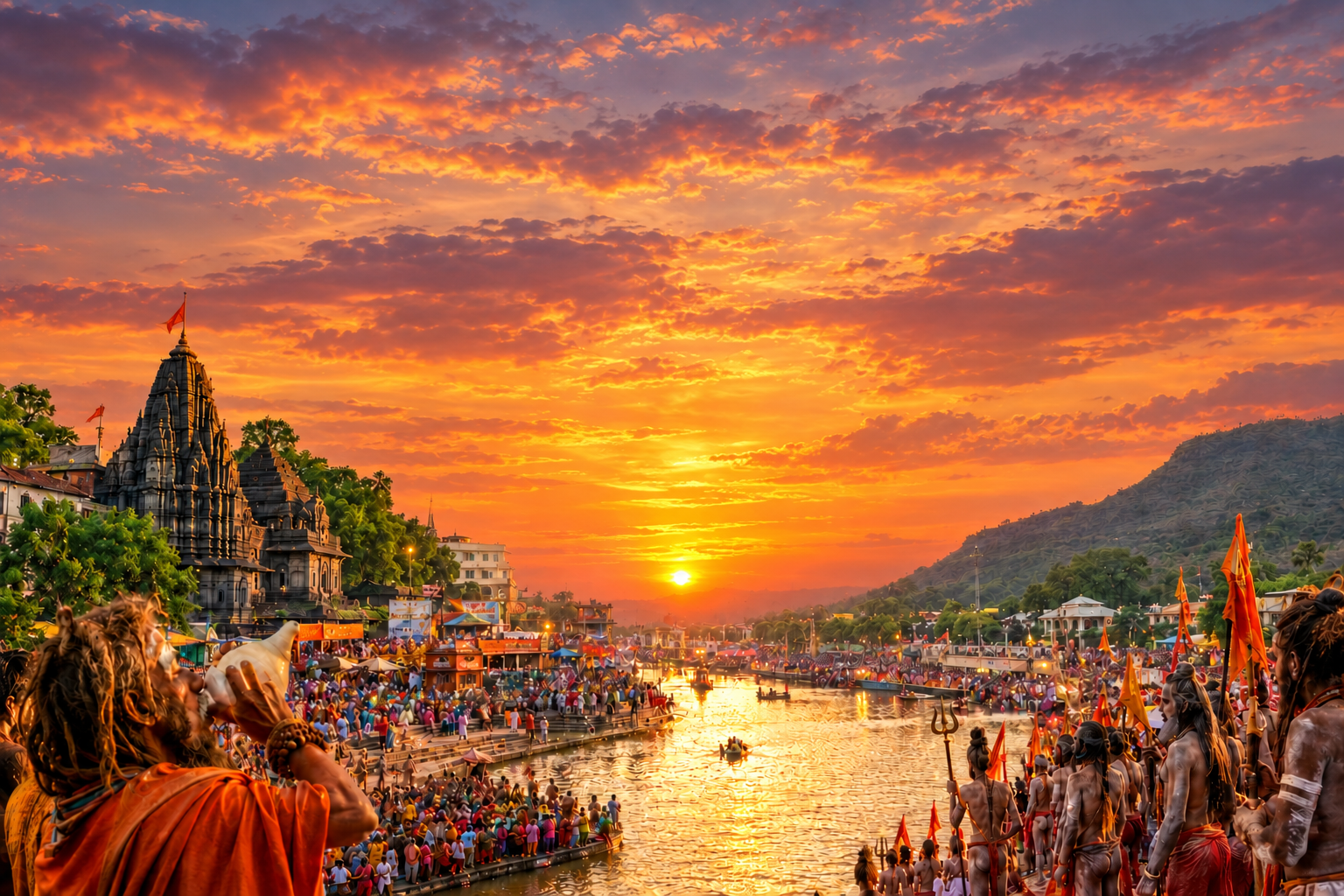

Why is Nashik Kumbh Called Simhastha
India hosts four major Kumbh Melas, rotating between Haridwar, Prayagraj, Ujjain, and Nashik. However, only the Nashik Kumbh (and occasionally Ujjain) carries the distinct title of Simhastha Kumbh.
For millions of devotees, the term “Simhastha” is sacred, yet many do not fully understand its origin. Why is the Nashik Kumbh called Simhastha while others are not? The answer is a fascinating blend of celestial mathematics and ancient Hindu mythology.
This article deciphers the astrological alignment that triggers the event and the mythological legend that gives it its divine “lion” energy.
The Astrological Reason: The Jupiter-Leo Conjunction
The primary and most definitive reason the Nashik Kumbh is called Simhastha lies in the movement of planets, specifically the planet Brihaspati (Jupiter).
What does “Simhastha” literally mean?
In Sanskrit:
- Simha means Lion.
- Stha means seated or positioned.
Together, “Simhastha” translates to “seated in the Lion.” In astrological terms, this means Jupiter is positioned in the zodiac sign of Leo (Simha Rashi).
The Rare Planetary Alignment
Unlike the Haridwar Kumbh (which occurs when Jupiter is in Aquarius) or the Prayagraj Kumbh (when Jupiter is in Taurus), the Nashik Simhastha Kumbh occurs under a highly specific dual condition:
- Jupiter enters Leo (Simha Rashi) – This happens once every 12 years.
- The Sun enters Aries (Mesha Rashi) – This marks the beginning of the solar year (Makar Sankranti’s equivalent in the Hindu calendar).
When both these celestial giants align simultaneously, the cosmic door to the Godavari River is believed to open, turning the water into Amrit (nectar). Because the entire event is “seated” in the sign of the lion, the fair is eternally named Simhastha.
The 12-Year Cosmic Clock
Unlike the annual Magh Mela, the Simhastha occurs strictly once every 12 years. This is because Jupiter takes approximately 12 years to complete one orbit around the Sun and traverse all 12 zodiac signs. When it enters Leo, the countdown to the Nashik Kumbh begins.
Keywords integrated: Simhastha Kumbh meaning, Nashik Kumbh astrology, Jupiter in Leo Kumbh, planetary alignment Kumbh Mela.
The Mythological Significance: The Legend of the Lion’s Guard
While astrology dictates the date, mythology dictates the name’s soul. Why is a lion associated with a river festival? The answer lies in the Samudra Manthan (churning of the ocean).
The Fall of the Nectar Drops
According to the Bhagavata Purana, the Devas (gods) and Asuras (demons) churned the cosmic ocean to obtain the pot of Amrit (immortality nectar). When the pot emerged, a fierce battle ensued. During the scuffle, drops of this nectar fell at four locations on Earth: Prayagraj, Haridwar, Ujjain, and Nashik.
The Role of Goddess Durga’s Vahana
At the Nashik site, the drop of Amrit fell near the Trimbakeshwar Jyotirlinga region.
- Hindu scriptures state that to protect this sacred drop from the Asuras who were chasing it, Goddess Durga (in her fierce form) dispatched her vahana (mount) – the lion (Simha) – to guard the location.
- The lion stood vigil over the nectar until the Devas could secure it.
- The name “Simhastha” is a perpetual tribute to this divine guardian. It signifies that the site is “seated under the protection of the Lion” (of Goddess Durga), ensuring that the spiritual energy of the Amrit remains intact for humanity to benefit from during the Kumbh.
The Shiva Connection at Trimbakeshwar
Another mythological thread links the “Simha” to Lord Shiva. Trimbakeshwar is the place where the Godavari originates. Lord Shiva is often depicted seated on a tiger or lion skin. The “Simhastha” name also honors Shiva’s absolute mastery over the “animalistic” (Simha) ego, urging devotees to shed their pride before taking the sacred dip.
Keywords integrated: Simhastha mythological story, Samudra Manthan nectar drops, Goddess Durga lion vahana, Trimbakeshwar Kumbh significance.
Distinguishing Simhastha from Other Kumbhs
To fully grasp the name, it helps to compare Nashik with other Kumbh cities:
|
Kumbh Location |
Planetary Condition |
Why the Name Differs |
|
Haridwar |
Jupiter in Aquarius (Kumbha Rashi) |
Called “Kumbh” because Jupiter is in the “Kumbha” (pot) sign. |
|
Prayagraj |
Jupiter in Taurus (Vrishabha) & Sun in Capricorn |
Called “Magh Mela” (seasonal) or simply “Ardh Kumbh”. |
|
Nashik / Ujjain |
Jupiter in Leo (Simha Rashi) |
Specifically called Simhastha due to the zodiac sign. |
Note: Ujjain also hosts a Simhastha, but Nashik’s Simhastha is uniquely tied to the Dakshin Ganga (Godavari) origin, making it geographically and ritually distinct.
Why Understanding “Simhastha” Matters for Devotees
Knowing why it is called Simhastha enhances the spiritual experience of the pilgrimage. It is not merely a crowd-gathering; it is a cosmic appointment.
- Ketu & Sun Dosha Nivaran: Astrologers recommend bathing during the Simhastha Kumbh for devotees suffering from planetary afflictions related to the Sun (Surya) or Ketu, as Leo is ruled by the Sun.
- Ancestral Salvation: The “Simha” energy is aggressive against negativity. Bathing on this date is believed to break the cycle of rebirth (Moksha) for the ancestors of the devotee.
Frequently Asked Questions(FAQs)
Q1: Is Simhastha only held in Nashik?
No, Ujjain also hosts the Simhastha Kumbh. However, Nashik's Simhastha is uniquely centered on the Godavari River and the Trimbakeshwar Jyotirlinga, which is the origin point of the river.
Q2: Why is Jupiter in Leo so special for the Kumbh?
When Jupiter, the planet of wisdom and expansion, enters Leo (ruled by the Sun, the soul), it creates a rare spiritual vortex. This alignment maximizes the purifying qualities of the holy water, which is why the Amrit Snan is performed during this phase.
Q3: How often does the Simhastha Kumbh occur?
It occurs once every 12 years, strictly aligning with Jupiter's transit into the Leo zodiac sign.
Q4: Does the name Simhastha have any connection to the Naga Sadhus?
Yes. The Naga Sadhus are "warrior" ascetics. They channel the aggressive, protective energy of the "Simha" (lion) during their Shahi Snan processions, charging into the water to protect the sanctity of the ritual.